
What is Overcurrent Protection?
Overcurrent Protection is a safety method that limits or interrupts electrical current when it exceeds a circuit's safe rating. Circuit breakers and fuses provide this protection by opening the circuit during overloads or short circuits. Proper protection helps prevent overheated conductors, damaged equipment, fires, and electrical shock hazards.
Quick Facts About Overcurrent Protection
Category
Electrical safety and circuit protection
Measured by
Amperes and interrupting rating
Used for
Overloads and short circuits
Common confusion
A breaker does not replace grounding or shock protection
Also called
Overcurrent Protection Device, OCPD
Often discussed with
Electrical Troubleshooting, Electrical Panel Upgrade
Key Takeaways About Overcurrent Protection
- Circuit breakers and fuses interrupt current when a circuit exceeds its permitted ampere rating.
- Overloads develop when connected equipment draws more current than the circuit can safely carry.
- Short circuits create very high current and require rapid interruption to limit damage.
- Protection must match conductor ampacity, equipment ratings, and the circuit's intended load.
- A breaker that trips repeatedly signals a problem, not a condition to ignore.
Understanding Overcurrent Protection
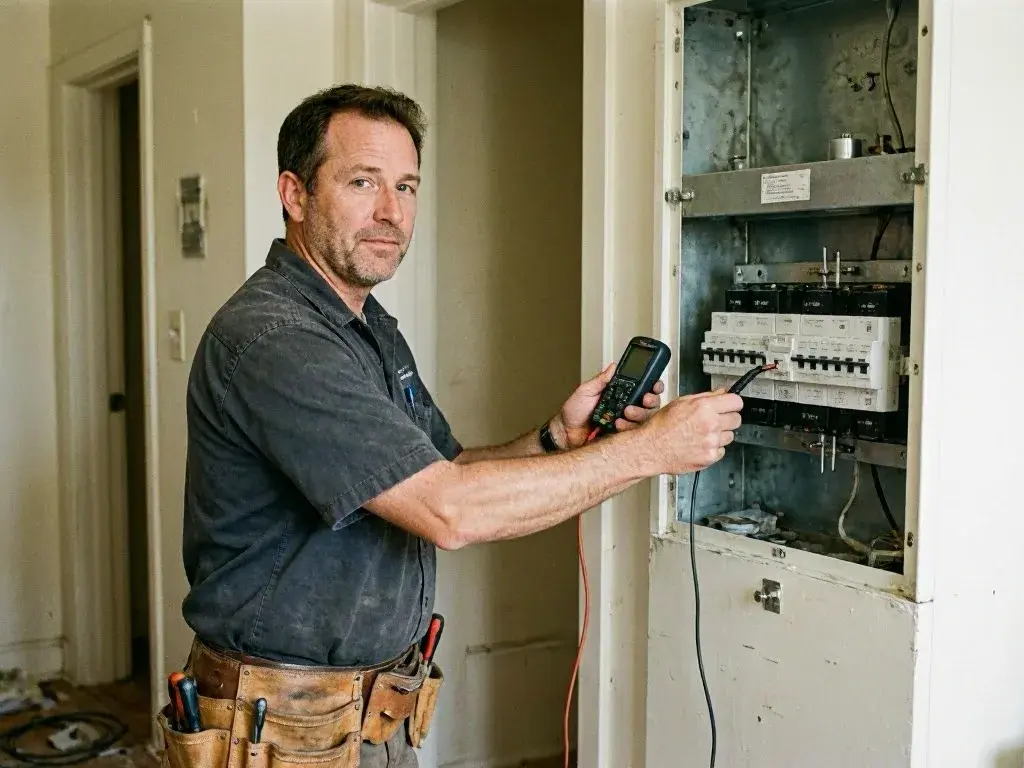
Overcurrent Protectionis part of an electrical system. It limits current to a safe level. It disconnects power when current becomes too high.circuit breaker opens its contacts during danger. A fuse melts an inner part and must be replaced. Both devices protect wires and equipment from heat caused by excess current.
Related glossary terms: Ampacity, Amperage, Branch Circuit.
Two common conditions need this response. An overloadoccurs when equipment draws more current than the circuit can carry. This can happen when several high-wattage appliances use one branch circuit.short circuit creates an unwanted path with little resistance. This path can create high current almost at once. The safety device must stop that current before damage occurs. It must protect insulation, terminals, and nearby materials from heat.
How Overcurrent Protection Works, Is Measured, or Is Used?
Protection starts with the circuit's ampacity. This means the most current a wire can carry safely. The breaker or fuse rating must match the wire size and insulation rating. It must also match the setup and equipment limits. For example, a larger breaker on small wire can cause overheating. The wire may overheat before the device trips.
Electricians check current with an ammeter. They check device ratings on the equipment label and panel schedule.interrupting ratingshows how much fault current a device can stop safely. The rating must match the fault current at that location. A full review also checks wire ends, panel condition, and circuit load. It checks the rules.National Electrical Code too.
During an overload, a thermal breaker may take time to trip. The heating effect builds slowly. A magnetic or electronic trip reacts much faster to a severe fault. Fuse and breaker action varies by design. Replacing a tripping device with another type can defeat protection. A larger rating can also defeat the intended protection.
Why Overcurrent Protection Matters?

Correct protection lowers the chance of wire damage. A wire may become hot enough to harm insulation or start nearby material burning. It also limits damage to motors, receptacles, panels, and other equipment. A device that trips reports an electrical problem. The problem needs review, even when power returns after resetting it.
Protection also supports sound design choices. A circuit with the right breaker, wire, and load check has fewer nuisance trips. It also has less hidden overheating. Grounding and bonding provide paths for fault current. They don't replace overcurrent protection. A ground-fault circuit interrupter serves a different main purpose.
When Overcurrent Protection Matters Most?
Overcurrent Protection needs close attention during panel changes and new circuit work. It also matters during rewiring and equipment replacement. Changes in load can make an existing breaker unsafe. This can happen even when the panel has open spaces. The review should include service capacity and feeder ratings. It should include branch-circuit wires and equipment maker instructions.
Repeated trips, warm breakers, and discolored outlets are warning signs. Buzzing, burning smells, and damaged insulation also need quick attention. Don't install a larger breaker to stop nuisance trips. Find the cause first. In Cincinnati homes and commercial buildings, old wiring can cause problems. Remodeled spaces and seasonal equipment can also create load mismatches. These mismatches can affect existing protection.
How to Evaluate Overcurrent Protection?
- Compare each breaker or fuse rating with the conductor ampacity and equipment instructions.
- Check the protective device interrupting rating against the available fault current.
- Record which loads operate when a breaker trips, especially heating and motor equipment.
- Look for warm panels, discoloration, damaged insulation, buzzing, or burning odors.
- Confirm that breaker type matches the panel manufacturer and listed installation requirements.
Related Concepts Compared
Overcurrent Protection vs. Grounding
Grounding connects parts of an electrical system to earth or a grounding source. It does not normally interrupt overload current, so grounding cannot replace a correctly rated breaker or fuse.
Overcurrent Protection vs. Ground-Fault Circuit Interrupter
A ground-fault circuit interrupter detects an imbalance between current leaving and returning through a circuit. Overcurrent protection responds mainly to excessive current from overloads and short circuits.
Overcurrent Protection vs. Arc-Fault Circuit Interrupter
An arc-fault circuit interrupter detects dangerous electrical arcing patterns. It may include overcurrent protection, but its arc detection function addresses a different hazard.
Overcurrent Protection vs. Ampacity
Ampacity is the amount of current a conductor can safely carry under specified conditions. Overcurrent protection is the method used to limit or interrupt current before the conductor exceeds its safe capacity.
Expert Note
A breaker can have the correct ampere rating and still be unsuitable if its panel type, voltage, poles, or interrupting rating is wrong. Repeated trips should lead to load and connection testing, not a larger breaker.
Common Mistakes or Myths About Overcurrent Protection
- Replacing a tripping breaker with a higher-rated breaker without checking wire size.
- Assuming a grounding conductor protects against every electrical hazard.
- Installing a breaker that is not listed for the panel.
- Ignoring warm outlets, burning odors, buzzing, or repeated trips.
- Treating a fuse as reusable after it has opened the circuit.
Overcurrent Protection in Practice: A Real-World Example
A kitchen branch circuit supplies a toaster oven and a portable heater at the same time. The combined load exceeds the circuit rating, so the thermal breaker trips after the conductors heat. Resetting the breaker without reducing the load or correcting the circuit does not solve the underlying problem.
Related Terms
Ampacity
Ampacity is the maximum current, measured in amperes, that a conductor can carry continuously under stated…
Amperage
Amperage is the amount of electric current flowing through a circuit, measured in amperes, commonly called…
Branch Circuit
Branch Circuit is the portion of an electrical system that carries power from a final overcurrent…
Electrical Load
Electrical Load is the amount of electrical power that devices, equipment, or circuits draw from a…
ElectricianCincinnatiOH.com
Have Questions About Overcurrent Protection?
Contact ElectricianCincinnatiOH.com for practical guidance on Overcurrent Protection and related 24 hour electrician work in Cincinnati.