
What is Service Drop?
Service Drop is the overhead electrical line that carries power from a utility pole or other utility support to a building’s service entrance. The service drop connects the utility distribution system to the customer-owned service equipment, usually at the meter or weatherhead. It contains insulated conductors and operates at the utility’s service voltage.
Quick Facts About Service Drop
Category
Electrical service connection
Used for
Delivering utility power to a building
Common confusion
Confused with the service entrance or underground service lateral
Also called
Overhead service, Overhead service drop
Often discussed with
Electrical Service Entrance Repair, Electrical Inspection
Key Takeaways About Service Drop
- A service drop links utility sharing lines to a building’s electrical service entrance.
- The utility usually owns and maintains conductors up to the service point.
- Clearances, attachment points, conductor condition, and weather affect safety.
- An overhead service drop differs from an underground service lateral.
- Damage can cut power and cause shock, fire, or falling-wire hazards.
Understanding Service Drop
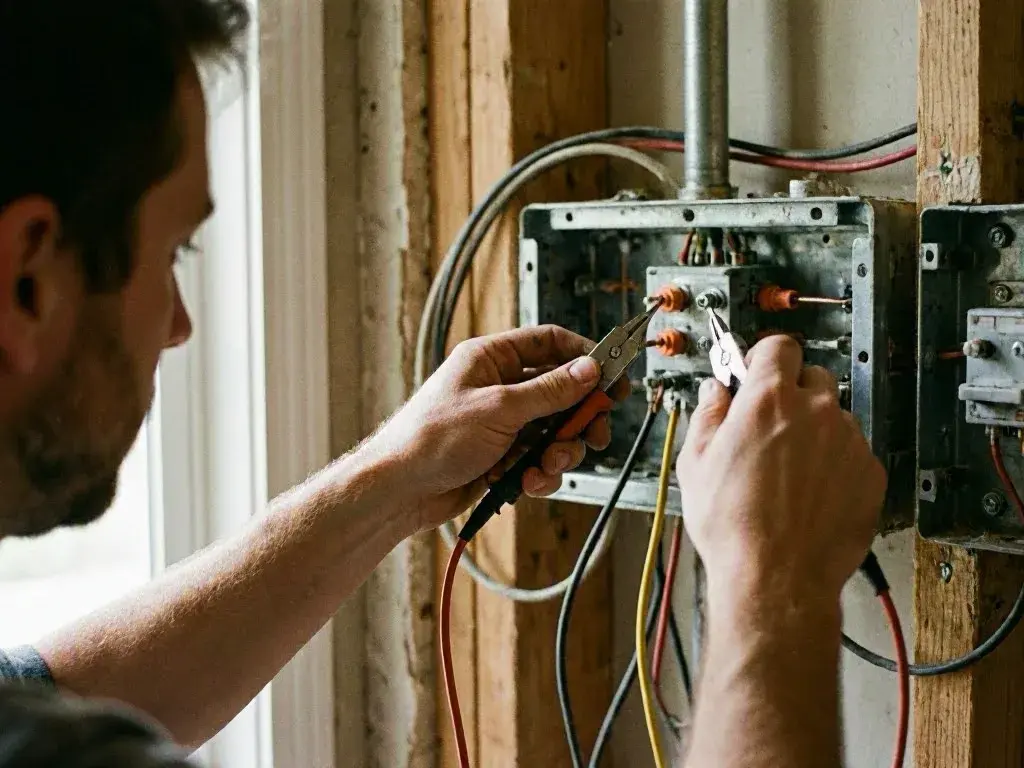
Service Dropis the overhead part of an electrical service. It runs from a utility pole or other utility support to a building. The conductors often end.weatherhead. They enter the service mast or another approved service entrance fitting. From there, conductors run toward the meter and main service equipment.
Related glossary terms: Electrical Load, Electrical Grounding, Line Voltage.
A typical service drop has insulated conductors for the energized lines. It may also have a neutral conductor, based on the utility design. The utility owns the conductors in many installations. The property owner handles the building-side equipment. The utility’s service rules show the exact ownership boundary. It may be marked at the point of delivery. A service drop isn't every wire near a building. Communication cables and branch-circuit conductors serve other purposes.
How Service Drop Works, Is Measured, or Is Used?
The utility distribution system supplies power at a voltage chosen for the area. It also depends on the building service. The service drop spans the space between the utility support and building attachment point. The conductors must keep the required clearance from many areas. These areas include roofs, windows, decks, driveways, streets, and other open spaces.service attachment supports the building end. Utility hardware supports the pole end.
Electricians and utility workers check several parts of a service drop. They check conductor condition, attachment strength, sag, clearance, and service rating. The service rating uses amperes, such as 100 or 200 amperes. The overhead conductor rating also depends on utility design and approved equipment. A visual check can find damaged insulation or a loose mast. Energized conductors need utility steps and proper electrical safety controls.
During installation or repair, workers first confirm the utility requirements. They inspect the service entrance and secure the attachment point. They also arrange any needed disconnect or reconnection. The meter socket, service mast, grounding equipment, and main disconnect must match. They must match the approved service design. Local rules may require a permit, inspection, or utility approval. Power may not return until these steps finish.
Why Service Drop Matters?
A damaged Service Dropcan affect the whole building. It supplies the main electrical service. Frayed insulation, heavy sag, or a broken attachment can expose live parts. A tree can also touch the service drop. These problems can pull hardware away from the structure. They can cause shock, arcing, fire, or sudden power loss.service entrance carries the building's full load. Defects need quick attention.
Correct design protects the utility system and the property. Proper clearance reduces contact with people and vehicles. It also reduces contact with ladders and building tools. A strong attachment limits strain on the conductors and building. Correctly finding the utility ownership boundary also prevents unsafe work. A property owner may otherwise work on utility equipment.
When Service Drop Matters Most?
Service drop issues often follow severe weather, tree growth, or roof work. They can also follow a vehicle impact or a service size change. Ice, wind, and falling branches can damage overhead conductors and attachments. Remodeling can place a roof, deck, or addition too close. A new heat pump may require a service review. An electric vehicle charger or workshop may also need one. The building load could exceed the current service capacity.
Before work starts near a service drop, identify the utility’s clearance rules. Find the location of energized equipment. Don't touch a fallen or damaged line. This applies even when the line seems inactive. Keep people away from the area. Avoid contact with water and metal. Report the condition to the utility or emergency services. A qualified electrician can check building-side equipment. The utility usually handles its overhead conductors and service connections.
How to Evaluate Service Drop?
- Check whether conductors have damaged insulation, exposed metal, unusual sag, or contact with trees and structures.
- Verify that the building attachment, weatherhead, service mast, and meter equipment remain secure and undamaged.
- Compare the service rating with the calculated building load before adding major electrical equipment.
- Confirm required clearances from roofs, windows, decks, driveways, streets, and accessible areas.
- Ask which party owns each component and whether utility approval or an electrical permit is required.
Related Concepts Compared
Service Drop vs. Service Lateral
A service lateral carries utility power underground from a utility source to a building. A service drop performs the same general connection above ground.
Service Drop vs. Service Entrance
The service entrance includes the building-side conductors and equipment that receive utility power. The service drop is the overhead utility connection leading to that equipment.
Service Drop vs. Distribution Line
A distribution line serves an area and may supply multiple properties. A service drop branches from that system to one building.
Expert Note
The ownership boundary is easy to misunderstand. Utility rules control the drop conductors, attachment method, meter equipment, and reconnection process in many locations. An electrician can inspect the building-side service entrance, but utility personnel must handle equipment within the utility’s jurisdiction.
Common Mistakes or Myths About Service Drop
- Assuming every overhead wire near a building belongs to the property owner.
- Touching or moving a fallen service conductor because the power appears to be off.
- Adding a roof, deck, or tree without checking required overhead clearances.
- Treating a loose weatherhead or service mast as a minor cosmetic issue.
- Replacing service equipment without coordinating utility approval and reconnection.
Service Drop in Practice: A Real-World Example
A branch falls across a home’s overhead service drop during a storm.
Sources & Further Reading on Service Drop
Related Terms
Electrical Load
Electrical Load is the amount of electrical power that devices, equipment, or circuits draw from a…
Electrical Grounding
Electrical Grounding is a safety system that connects electrical equipment and circuits to the earth or…
Line Voltage
Line Voltage is the electrical potential supplied by a utility or power system to a circuit…
Overcurrent Protection
Overcurrent Protection is a safety method that limits or interrupts electrical current when it exceeds a…
ElectricianCincinnatiOH.com
Have Questions About Service Drop?
Contact ElectricianCincinnatiOH.com for practical guidance on Service Drop and related 24 hour electrician work in Cincinnati.