
What is an Ohm?
Ohm is the SI unit of electrical resistance, identified by the symbol Ω. One ohm of resistance allows one ampere of current to flow when one volt is applied. The unit describes how strongly a material or device opposes current, and it helps electricians select conductors, test circuits, and diagnose electrical faults.
Quick Facts About Ohm
Category
SI unit of electrical resistance
Symbol
Ω
Formula
R = V ÷ I
Measured by
Ohmmeter or digital multimeter
Common confusion
Ohms measure resistance, not current or voltage
Also called
Ω, ohms
Key Takeaways About Ohm
- Resistance is measured in ohms and represented by the Greek letter omega, Ω.
- One ohm permits one ampere of current when one volt is applied.
- Higher resistance usually means less current at the same applied voltage.
- Ohm’s Law connects resistance, voltage, and current through R = V ÷ I.
- A resistance reading can reveal broken wires, shorts, poor connections, or damaged components.
Understanding Ohm

Ohm is the unit used to describe electrical resistance. Resistance opposes electric charge moving through a conductor, device, or circuit. The unit's named after German physicist Georg Simon Ohm. Its symbol is the Greek letter omega, Ω. A larger resistance value generally means less current flows at the same voltage.
Related glossary terms: Ohm's Law, Voltage, Amperage.
The relationship becomes clear through a simple example. A one-ohm load has one volt across it when one ampere flows through it. A 10-ohm load needs 10 volts to carry one ampere. This applies under the same basic conditions. Resistance appears in wire, heating elements, motors, lamps, electronics, and connections. Each material and device responds differently to temperature and operating conditions.
How Ohm Works, Is Measured, or Is Used?
Ohm’s Law connects voltage, current, and resistance with the formula R = V ÷ I. R represents resistance in ohms. V represents voltage in volts. I represents current in amperes. You can rearrange the formula to calculate voltage as V = I × R. You can also calculate current as I = V ÷ R.
An electrician measures resistance with an ohmmeter. It's usually one function of a digital multimeter. Power must be turned off before a resistance test begins. Stored energy must be discharged when the equipment requires it. The meter sends a small test current through the isolated component. It then calculates resistance from the measured voltage and current. A reading near zero can indicate continuity or an unintended short. An open circuit may show OL or an equivalent over-range message.
Measured resistance must match the test conditions. Parallel paths can produce a lower reading than one component's value. Connected electronic parts can distort a test. Temperature also changes resistance, especially in conductors, heating elements, and motor windings. For accurate troubleshooting, the tested part may need disconnection from the circuit.
Why Ohm Matters?
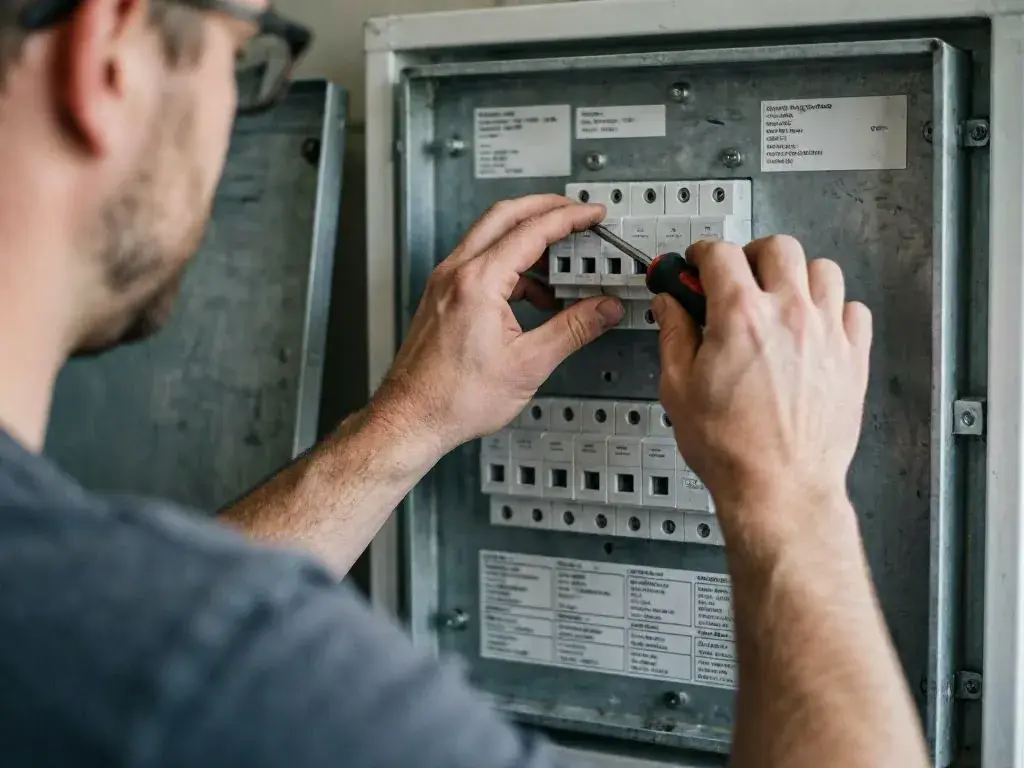
Resistance controls current and affects heat, voltage drop, and equipment performance. A loose terminal can add unwanted resistance and create heat. It can also damage the connection over time. A short circuit has very low resistance. The resulting current can rise quickly until a fuse or circuit breaker interrupts it.
Ohm values also support design decisions. A conductor with excessive resistance can cause lights to dim. It can cause motors to run poorly. It can also make sensitive equipment lose voltage. Correct measurements help distinguish a failed component from a supply problem. They also provide evidence during electrical troubleshooting, inspection, and repair.
When Ohm Matters Most?
Ohm readings matter during continuity testing, motor testing, and fault diagnosis. An electrician may compare winding resistance between motor terminals. They may check a heating element against its rated value. They may verify that a wire remains continuous from one end to the other. A reading that differs sharply from the manufacturer’s specification can point to an open winding. It can also point to a shorted turn or damaged connection.
Safety comes first during every resistance test. Never place an ohmmeter across an energized circuit. The meter and circuit can be damaged. The test should also account for capacitors, parallel branches, and parts that store energy. In Cincinnati homes and commercial buildings, these checks can help locate wiring defects. They can also find failing equipment and abnormal circuit conditions before repair or replacement.
How to Evaluate Ohm?
- Confirm that the meter is set to resistance and that the circuit is de-energized before testing.
- Compare the measured value with the component manufacturer’s rated resistance.
- Check whether parallel circuit paths or connected electronics could lower or alter the reading.
- Look for OL, infinite resistance, or near-zero readings when testing for an open circuit or short.
- Inspect terminals and splices when resistance is higher than expected or changes during movement.
Related Concepts Compared
Ohm vs. Voltage
Voltage is the electrical pressure that drives current. Ohms measure the resistance that opposes that current.
Ohm vs. Amperage
Amperage measures the amount of current flowing through a circuit. Ohms measure the circuit’s opposition to that flow.
Ohm vs. Ohm’s Law
Ohm is a unit of resistance. Ohm’s Law is the formula that relates resistance, voltage, and current.
Ohm vs. Continuity
Continuity describes whether a conductive path exists. A low-ohm reading can confirm continuity, but continuity and resistance are not identical terms.
Expert Note
A resistance reading is meaningful only when the test setup is correct. Turn power off, isolate the component when practical, discharge capacitors, and account for parallel paths. A normal reading does not prove that insulation is safe, since insulation testing may require a specialized megohmmeter.
Common Mistakes or Myths About Ohm
- Treating ohms as a measure of voltage or current.
- Testing resistance on an energized circuit.
- Assuming a low reading always proves a short without checking parallel paths.
- Ignoring temperature and manufacturer specifications when judging a resistance value.
- Leaving connected electronic components in the circuit during a precision resistance test.
Ohm in Practice: A Real-World Example
A 120-volt heating element measures 24 ohms when disconnected from the circuit. Ohm’s Law predicts about 5 amperes because 120 divided by 24 equals 5. If the same element reads OL, it likely has an open internal connection.
Sources & Further Reading on Ohm
- National Institute of Standards and Technology, SI Units
- BIPM, The International System of Units, SI Brochure
- National Institute of Standards and Technology, Electrical Measurements
Related Services
Related Terms
Ohm's Law
Ohm's Law is the relationship between voltage, current, and resistance in an electrical circuit. The law…
Voltage
Voltage is the electrical pressure that drives current through a circuit. Measured in volts, voltage represents…
Amperage
Amperage is the amount of electric current flowing through a circuit, measured in amperes, commonly called…
Continuity Test
Continuity Test is an electrical check that determines whether a complete conductive path exists between two…
ElectricianCincinnatiOH.com
Have Questions About Ohm?
Contact ElectricianCincinnatiOH.com for practical guidance on Ohm and related 24 hour electrician work in Cincinnati.