
What is Ohm's Law?
Ohm's Law is the relationship between voltage, current, and resistance in an electrical circuit. The law states that voltage equals current multiplied by resistance, written as V = I × R. This formula helps you calculate an unknown electrical value when the other two values are known and measured under consistent conditions.
Quick Facts About Ohm's Law
Category
Electrical principle
Formula
V = I × R
Measured by
Digital multimeter
Used for
Circuit calculations and troubleshooting
Common confusion
Ohm's Law does not replace ampacity rules
Also called
V = I × R, Voltage-current-resistance relationship
Key Takeaways About Ohm's Law
- Voltage pushes electrical current through resistance.
- Current is measured in amperes, voltage in volts, and resistance in ohms.
- The basic formulas are V = I × R, I = V ÷ R, and R = V ÷ I.
- Higher resistance reduces current when voltage stays constant.
- Circuit temperature and component type can affect practical results.
Understanding Ohm's Law
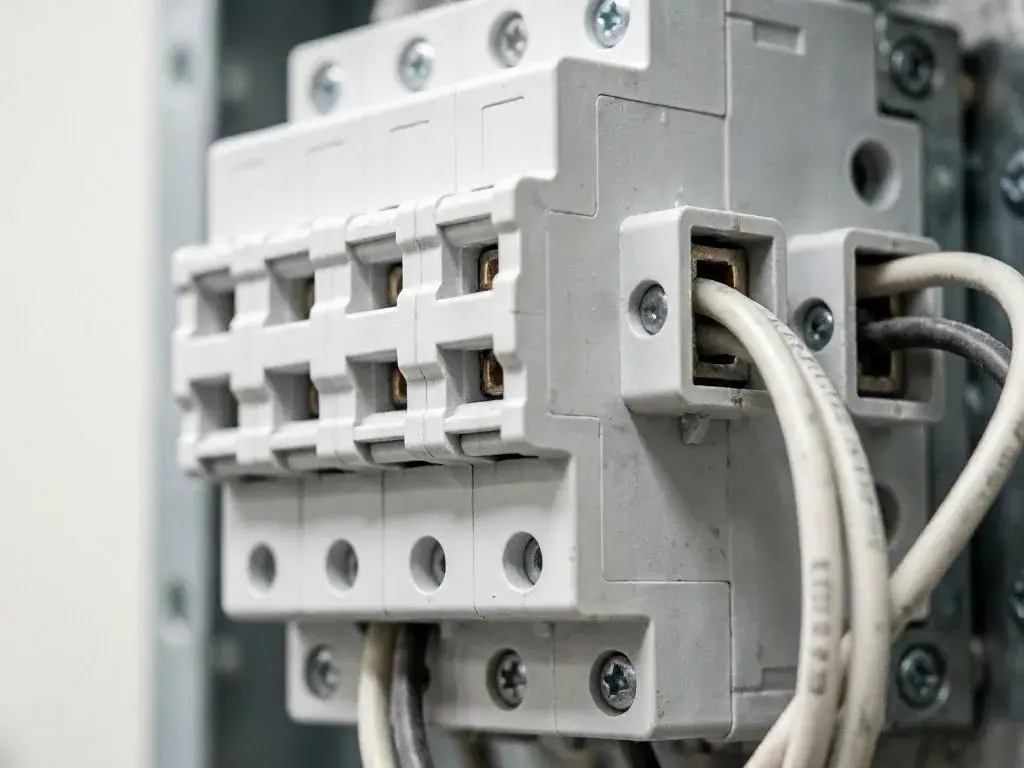
Ohm's Law describes the connection among voltage, current, and resistance in an electrical circuit. Voltage is the electrical pressure that drives charge. Current is the rate of charge flow, and resistance opposes that flow. The law gives electricians and engineers a consistent way to relate these three values.
Related glossary terms: Ohm, Voltage, Amperage.
The standard formula is V = I × R. In this formula, V represents voltage in volts. I represents current in amperes. R represents resistance in ohms. If you know any two values, you can calculate the third. For example, a 12-volt source connects to a 6-ohm load. It produces 2 amperes under the stated conditions.
How Ohm's Law Works, Is Measured, or Is Used?
Rearranging the formula creates three useful equations. Use I = V ÷ R to find current. Use R = V ÷ I to find resistance. Use V = I × R to find voltage. A technician may measure voltage across a component and current through a circuit. The technician can then compare the results with the expected resistance.
A digital multimeter can measure voltage, resistance, and current. The meter needs the correct setting and connection. Voltage is measured across a component. Current is measured in series with the circuit. Resistance tests require the circuit to be de-energized. Applying power during an ohms test can damage the meter. It can also create a hazardous condition.
Ohm's Law works most directly with a component that has stable resistance. A fixed resistor often follows the relationship closely.motor, lamp, heating element, or semiconductor may change resistance. Temperature, speed, or other conditions may cause this change. The measured values may not match a simple fixed-resistance estimate.
Why Ohm's Law Matters?
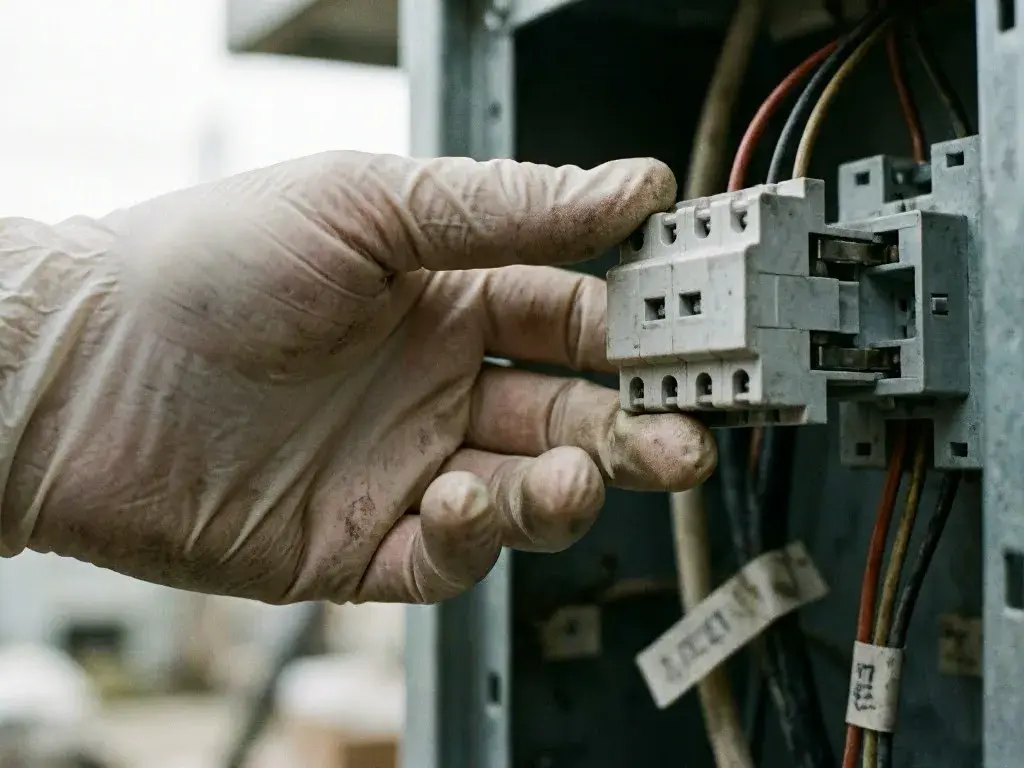
Ohm's Law helps identify abnormal circuit behavior before a small fault becomes a larger problem. If a circuit draws more current than expected, the cause may include low resistance. It may also include a short circuit, an incorrect load, or damaged insulation. If current is lower than expected, an open connection may be involved. Excessive resistance or a weak supply may also be involved.
The relationship also supports decisions about wire size, load current, and overcurrent protection. The formula alone doesn't approve a wiring method or breaker size. Electrical work must also account for ampacity, equipment ratings, installation conditions, and applicable electrical codes.
When Ohm's Law Matters Most?
Ohm's Law becomes especially useful during electrical troubleshooting. A technician can compare supply voltage, load current, and resistance readings. These readings can help locate an open circuit, poor connection, overloaded branch circuit, or failed component. The comparison works best when measurements are taken safely at known test points.
The principle also matters during design, installation, and inspection. A calculated current helps determine whether a circuit can support a planned load. A voltage-drop calculation can show whether long conductors may reduce equipment performance. Undersized conductors may also reduce performance. In Cincinnati homes and commercial buildings, these checks support accurate electrical troubleshooting and electrical inspection decisions. They don't replace a complete code review.
How to Evaluate Ohm's Law?
- Check that voltage, current, and resistance use compatible units before applying the formula.
- Compare calculated current with the conductor ampacity and overcurrent protection rating.
- Confirm that resistance measurements occur with the circuit de-energized.
- Look for voltage drop when conductors are long or equipment starts under load.
- Question readings that change sharply with temperature, motor speed, or operating state.
Related Concepts Compared
Ohm's Law vs. Voltage
Voltage is one variable in Ohm's Law, not the law itself. It describes electrical potential difference and is measured in volts.
Ohm's Law vs. Amperage
Amperage is the amount of current flowing in a circuit. Ohm's Law explains how that current relates to voltage and resistance.
Ohm's Law vs. Watt's Law
Watt's Law connects power with voltage and current, such as P = V × I. Ohm's Law connects voltage, current, and resistance.
Ohm's Law vs. Kirchhoff's Laws
Kirchhoff's laws describe current and voltage relationships at circuit junctions and around loops. Ohm's Law describes the voltage-current relationship of a component or circuit.
Expert Note
A resistance reading is not always the operating resistance of a load. Motors and heating elements change behavior as they run, so compare cold readings, energized measurements, nameplate data, and circuit conditions before drawing a conclusion.
Common Mistakes or Myths About Ohm's Law
- Treating voltage, current, and resistance as interchangeable values.
- Measuring resistance on an energized circuit.
- Assuming every load has a constant resistance during operation.
- Sizing a breaker from Ohm's Law alone without checking conductor ampacity and code requirements.
- Confusing power in watts with current in amperes.
Ohm's Law in Practice: A Real-World Example
A 120-volt circuit supplies a 24-ohm heating element. Applying I = V ÷ R gives 120 ÷ 24, or 5 amperes. If the measured current is much higher, the element or circuit may have an abnormal low-resistance condition.
Sources & Further Reading on Ohm's Law
Related Services
Related Terms
Ohm
Ohm is the SI unit of electrical resistance, identified by the symbol Ω. One ohm of…
Voltage
Voltage is the electrical pressure that drives current through a circuit. Measured in volts, voltage represents…
Amperage
Amperage is the amount of electric current flowing through a circuit, measured in amperes, commonly called…
Electrical Load
Electrical Load is the amount of electrical power that devices, equipment, or circuits draw from a…
ElectricianCincinnatiOH.com
Have Questions About Ohm's Law?
Contact ElectricianCincinnatiOH.com for practical guidance on Ohm's Law and related 24 hour electrician work in Cincinnati.