
What is a Voltage?
Voltage is the electrical pressure that drives current through a circuit. Measured in volts, voltage represents the difference in electric potential between two points. A source such as a battery, utility service, or transformer creates this difference. Current flows when a complete path connects points with unequal voltage.
Quick Facts About Voltage
Category
Electrical quantity
Measured by
Voltmeter or multimeter
Formula
V = I × R
Common confusion
Voltage is not the same as current
Also called
Electrical potential difference, Electric potential
Often discussed with
Electrical Troubleshooting, Electrical Inspection
Key Takeaways About Voltage
- Voltage is measured in volts and describes electrical potential difference between two points.
- Current needs both voltage and a complete conducting path before it can flow.
- Higher voltage can deliver more energy and create greater shock and arc risks.
- A multimeter measures voltage between selected circuit points, not at one point alone.
Understanding Voltage
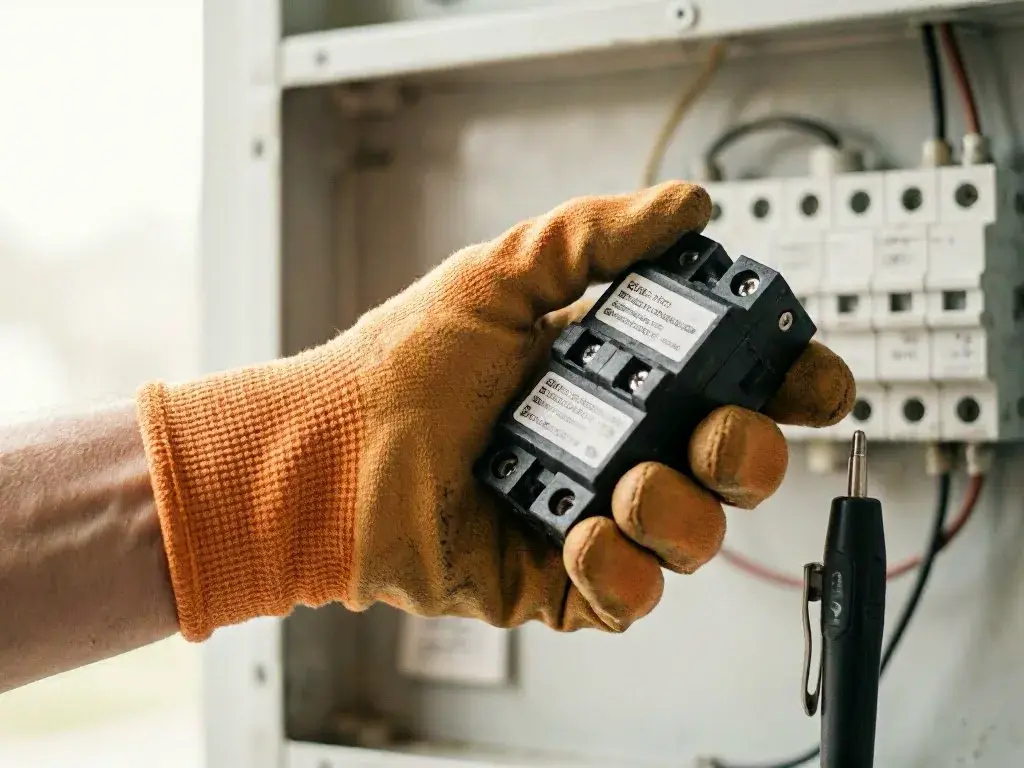
Voltageis the difference in electrical potential between two points. It acts like pressure that can move electric charge through a conductor. The unit's.volt, represented by the letter V. A battery, utility service, or transformer can create needed voltage. This voltage lets a circuit operate.
Related glossary terms: Amperage, Electrical Load, Line Voltage.
Voltage doesn't mean that current is already flowing. Current requires a complete path, such as a closed switch and connected wiring. A wall receptacle may have voltage. But no current flows without a plug. The voltage becomes useful when a load connects across the circuit. A lamp or motor can serve as a load.
How Voltage Works, Is Measured, or Is Used?
Voltage is measured between two points with a voltmeter or digital multimeter. The meter connects in parallel, which means its probes touch both points. A reading near zero volts shows little potential difference between the probes. A higher reading shows greater electrical pressure.
Voltage, current, and resistance link through Ohm's Lawwritten as V = I × R. In this formula, V is voltage, I is current in amperes, and R is resistance in ohms. If resistance stays constant, raising voltage raises current. A 120-volt circuit and a 240-volt circuit can power different loads. Each needs wiring, equipment, and protection rated for its voltage.
Electric systems may use alternating current or direct current. Utility power normally changes direction many times each second. Batteries supply direct current with a fixed polarity. A multimeter must use the correct AC or DC setting. Probes should touch the intended test points. The meter range should match the expected value.
Why Voltage Matters?
Voltage affects whether equipment starts, runs well, and stays within design limits. Too little voltage can make motors overheat or cause lights to flicker. It can also stop electronic controls from working correctly. Too much voltage can damage insulation, circuit boards, motors, and other equipment.
Voltage also affects shock risk and arc flash risk. The danger depends on more than the voltage rating. Available current, contact conditions, equipment design, and fault energy also matter. A circuit can remain dangerous after a breaker trips. Another source may still supply power. Examples include a generator or stored energy device.
When Voltage Matters Most?
Voltage becomes important during troubleshooting, equipment installation, and electrical inspections. A technician may compare voltage at the panel, receptacle, and load. These readings can show a loose connection, damaged conductor, failed breaker, or overloaded circuit. Differences between readings can reveal where electrical energy is lost.
Check voltage before replacing equipment or selecting circuit wiring. Confirm the equipment nameplate, circuit rating, breaker rating, and supply voltage agree. Line voltage measurements need proper test equipment and safe steps. People without electrical training shouldn't open energized panels. They shouldn't test exposed conductors.
How to Evaluate Voltage?
- Confirm the equipment nameplate voltage matches the measured supply voltage.
- Measure between the correct two points, using the multimeter setting for AC or DC.
- Compare voltage at the source and load to identify excessive voltage drop.
- Check conductor, breaker, and equipment ratings against the circuit voltage.
- Treat any unexpected energized reading as a safety warning until its source is identified.
Related Concepts Compared
Voltage vs. Amperage
Amperage is the amount of electric current flowing through a circuit. Voltage is the potential difference that drives that current.
Voltage vs. Wattage
Wattage measures electrical power, or the rate of energy use. Power can be calculated from voltage multiplied by current.
Voltage vs. Resistance
Resistance opposes current flow and is measured in ohms. Voltage must overcome resistance to produce current.
Voltage vs. Line Voltage
Line voltage is voltage supplied by a power system to equipment or a circuit. Voltage is the broader electrical quantity, while line voltage describes a specific supply relationship.
Expert Note
A voltage reading alone does not prove that a circuit can deliver usable power. A weak connection may show normal voltage with no load, then drop sharply when a motor or heating appliance operates.
Common Mistakes or Myths About Voltage
- Assuming voltage and amperage describe the same electrical quantity.
- Testing a circuit with the meter set to the wrong AC or DC mode.
- Measuring one conductor to an unsuitable reference point.
- Assuming a normal no-load reading rules out a loose connection.
- Touching exposed conductors because the expected voltage seems low.
Voltage in Practice: A Real-World Example
A receptacle may measure about 120 volts with no appliance connected. If the reading falls substantially when a vacuum starts, a loose connection, damaged conductor, or overloaded circuit may be causing voltage drop. The condition needs safe testing before continued use.
Sources & Further Reading on Voltage
Related Services
Related Terms
Amperage
Amperage is the amount of electric current flowing through a circuit, measured in amperes, commonly called…
Electrical Load
Electrical Load is the amount of electrical power that devices, equipment, or circuits draw from a…
Line Voltage
Line Voltage is the electrical potential supplied by a utility or power system to a circuit…
Ohm
Ohm is the SI unit of electrical resistance, identified by the symbol Ω. One ohm of…
ElectricianCincinnatiOH.com
Have Questions About Voltage?
Contact ElectricianCincinnatiOH.com for practical guidance on Voltage and related 24 hour electrician work in Cincinnati.