
What is a Transformer?
Transformer is an electrical device that transfers alternating-current energy between circuits while raising or lowering voltage. It uses electromagnetic induction between coils around a magnetic core. Transformers can provide isolation, match voltage to equipment, and support efficient power distribution. The device changes voltage and current levels without changing the alternating-current frequency.
Quick Facts About Transformer
Category
Electrical power conversion device
Used for
Changing AC voltage and providing circuit isolation
Common confusion
A transformer changes voltage, not electrical frequency
Also called
Voltage transformer, Control transformer
Often discussed with
Electrical Troubleshooting, Commercial Electrical Repair
Key Takeaways About Transformer
- Transformers raise or lower alternating-current voltage through electromagnetic induction.
- A transformer does not usually change the frequency of incoming AC power.
- The turns ratio between coils sets the main voltage change.
- Overheating, buzzing, oil leaks, and damaged insulation can show transformer trouble.
- Transformers may provide electrical isolation between the source and connected equipment.
Understanding Transformer
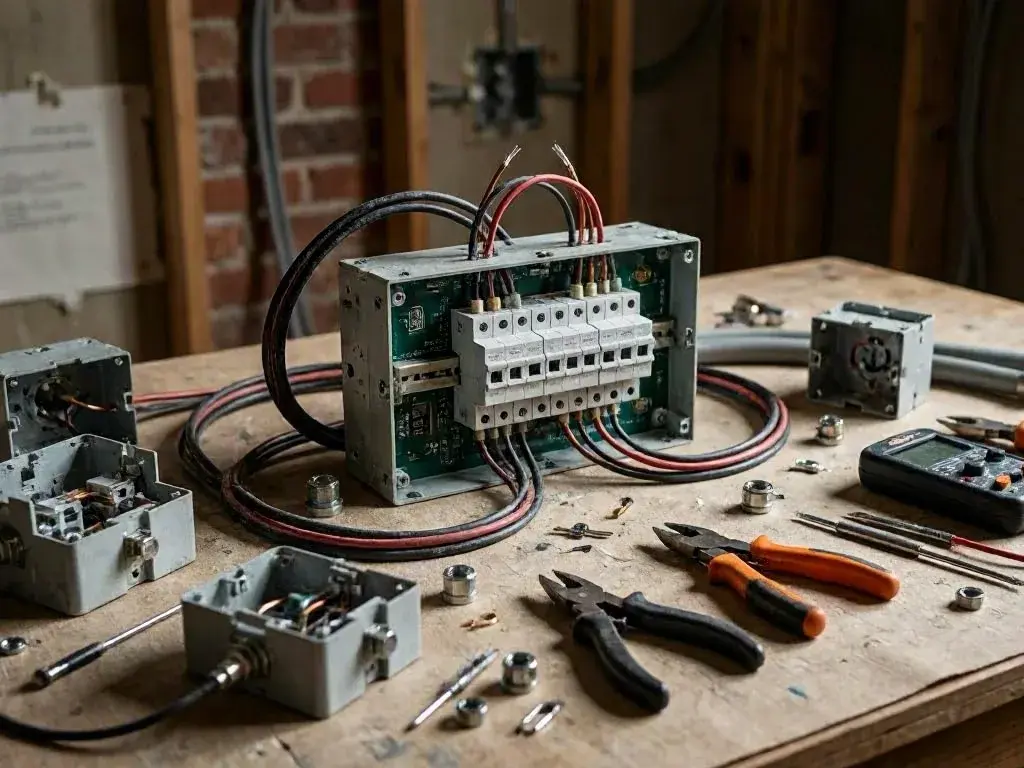
Transformer is a stationary electrical device. It transfers energy between two or more circuits through electromagnetic induction. Its main parts include a primary winding, a secondary winding, and a magnetic core. Alternating current flows in the primary winding. This current creates a changing magnetic field. The field induces voltage in the secondary winding.
Related glossary terms: Voltage, Line Voltage, Electrical Load.
The voltage relationship depends on the turns in each winding. A step-down transformerlowers voltage for equipment such as doorbells, control circuits, and low-voltage lighting.step-up transformer raises voltage for some transmission and industrial uses. Many transformers also provide electrical isolation. This feature separates the connected circuit from supply conductors.
How Transformer Works, Is Measured, or Is Used?
A transformer follows the turns-ratio relationship Vp/Vs = Np/Ns. Vp and Vs show primary and secondary voltage. Np and Ns show primary and secondary winding turns. If the secondary winding has fewer turns, its voltage is lower. Current changes in the opposite direction. Lower voltage usually permits higher current for similar power transfer.
Transformers operate with alternating current because the magnetic field must keep changing. Common measurements include primary voltage, secondary voltage, rated apparent power in volt-amperes, temperature rise, insulation condition, and load current. A transformer rated at 24 volts and 40 VA can supply a 24-volt control circuit. The circuit must stay within its rated load and installation limits.
Residential and commercial systems use several transformer types. A utility transformer reduces distribution voltage before power enters a building. A control transformer supplies equipment controls. Dry-type transformers use air and solid insulation. Liquid-filled units use insulating fluid. They need different clearances, maintenance, and fire-safety measures.
Why Transformer Matters?

Transformer selection affects equipment speed, energy loss, and personal safety. The secondary voltage must match the equipment rating. The transformer must have enough capacity for the connected load. An undersized unit may run hot, produce unstable voltage, or fail early. An incorrectly connected winding can also create a dangerous voltage condition.
Efficiency depends on the transformer design and operating load. A transformer loses energy through winding resistance and core losses. This loss happens even when the connected load is small. Proper overcurrent protection, grounding, ventilation, and conductor sizing help control these risks. The installation also needs space for inspection and safe servicing.
When Transformer Matters Most?
Transformer issues become important when equipment gets the wrong voltage. They also matter when a control circuit stops working. A unit may also show signs of overheating. Common warning signs include a sharp burning odor, discolored insulation, repeated protective-device operation, unusual vibration, and a persistent loud hum. A warm enclosure can be normal. Rapidly increasing heat needs prompt investigation.
Replacement decisions should consider voltage, phase, frequency, VA or kVA capacity, enclosure type, connection arrangement, and available fault protection. The existing load should be measured. Don't estimate it from the transformer label alone. In Cincinnati buildings, seasonal heating, cooling, pumps, and older wiring can change demand. The transformer and its circuit protection should be checked with the full electrical system.
How to Evaluate Transformer?
- Compare the primary and secondary voltage ratings with the equipment nameplate and measured circuit voltage.
- Check the transformer VA or kVA rating against the connected load and expected starting current.
- Inspect enclosure temperature, ventilation, insulation, terminals, vibration, and signs of arcing or oil leakage.
- Verify overcurrent protection, grounding, conductor sizing, and working clearance against the adopted electrical code.
- Confirm that the transformer type matches the location, including dry, liquid-filled, indoor, outdoor, or hazardous-area requirements.
Related Concepts Compared
Transformer vs. Autotransformer
An autotransformer uses one winding with shared sections instead of separate primary and secondary windings. It can be smaller and more efficient, but it does not provide the same electrical isolation.
Transformer vs. Power Supply
A power supply is a broader device category that converts or conditions electrical energy. A transformer may be one part of a power supply, but a power supply can also include rectifiers, regulators, switches, and filters.
Transformer vs. Voltage Regulator
A voltage regulator keeps output voltage within a target range as input voltage or load changes. A transformer mainly changes voltage by its winding ratio and does not automatically maintain a constant output.
Transformer vs. Inverter
An inverter converts direct current into alternating current. A transformer normally transfers and changes alternating-current voltage without changing the current frequency.
Expert Note
A transformer label shows rated capacity. Not guaranteed available capacity under every condition. Motor starting current, enclosure temperature, ventilation, harmonics, and ambient heat can reduce practical speed. Measure the load and inspect connections before selecting a replacement.
Common Mistakes or Myths About Transformer
- Assuming a transformer can change direct current voltage without added switching equipment.
- Choosing a replacement by physical size instead of voltage, VA rating, phase, and connection requirements.
- Ignoring motor starting current when sizing a transformer.
- Treating a loud hum, hot enclosure, or burning odor as normal operating behavior.
- Removing grounding or overcurrent protection because the transformer is low voltage.
Transformer in Practice: A Real-World Example
A building control panel gets 120 volts but needs 24 volts for heating control. A 120-to-24-volt control transformer provides lower voltage, and its VA rating must cover the thermostat, relays, and connected valves.
Sources & Further Reading on Transformer
Related Terms
Voltage
Voltage is the electrical pressure that drives current through a circuit. Measured in volts, voltage represents…
Line Voltage
Line Voltage is the electrical potential supplied by a utility or power system to a circuit…
Electrical Load
Electrical Load is the amount of electrical power that devices, equipment, or circuits draw from a…
Overcurrent Protection
Overcurrent Protection is a safety method that limits or interrupts electrical current when it exceeds a…
ElectricianCincinnatiOH.com
Have Questions About Transformer?
Contact ElectricianCincinnatiOH.com for practical guidance on Transformer and related 24 hour electrician work in Cincinnati.